NASA Solar and Space Weather History
NASA solar research began with sounding rockets and ground observatories that produced the first ultraviolet and X‑ray solar spectra in the 1940s–1960s. Skylab in 1973–1974 established long-duration coronal imaging and spectroscopic baselines that reshaped models of coronal heating and mass ejection. Since the 1990s, a coordinated fleet of spacecraft has formed a continuous, multi-point capability that supports operational space weather services used by industry and government.
Major missions, instruments, discoveries, operations and societal impact
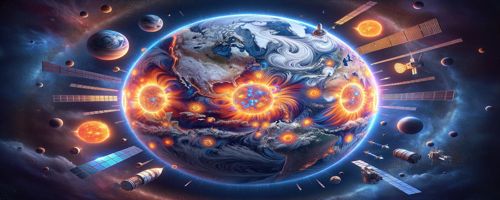
Early rocket flights delivered first coronal X‑ray detections and validated coronagraph concepts that later flew on Skylab and SOHO. Skylab’s Apollo Telescope Mount instruments mapped active-region evolution with daily cadence and recorded flare energetics that anchored magnetic reconnection theory. The formalization of a dedicated program to observe solar drivers and near‑Earth conditions followed as satellite services and power systems became increasingly vulnerable to geomagnetic storms.
Instrumentation evolved into four core families: extreme ultraviolet and X‑ray imagers for coronal structure; coronagraph and wide‑angle imagers for mass ejections; magnetometers and vector field sensors for onboard and in situ magnetic mapping; and plasma and particle detectors for solar wind and energetic particle characterization. These instrument types now appear across flagship platforms, small satellites, and hosted payloads.
- EUV and X‑ray imagers reveal rapid heating and flare kernels with high temporal resolution.
- Coronagraphs and heliospheric imagers track coronal mass ejections from launch through interplanetary space.
- Magnetometers and plasma analyzers measure field topology and particle distributions that determine geoeffectiveness.
- Radio and spectroscopic instruments provide electron density and shock diagnostics critical to propagation models.
Below is a consolidated reference of major missions, launch dates, principal instruments, and primary scientific or operational contributions, presented to support cross‑mission analysis and forecasting model development.
| Mission | Launch date | Key instruments / suites | Primary contributions / notable responses |
|---|---|---|---|
| SOHO | 1995-12-02 | LASCO coronagraphs, SUMER spectrometer, MDI | Continuous coronal imaging, CME cataloging since 1996; critical for 2003 storms analysis |
| SDO | 2010-02-11 | AIA (EUV imager), HMI (vector magnetograph) | High-cadence full-disk imaging, magnetic field evolution and flare onset studies |
| Parker Solar Probe | 2018-08-12 | SWEAP (plasma), FIELDS (EM fields), ISʘIS (particles) | In situ sampling within ~10 solar radii, constraints on solar wind acceleration |
| Solar Orbiter (ESA/NASA) | 2020-02-10 | EUI, Metis, PHI, SoloHI | Remote/near-Sun coordination, first high-latitude imaging of poles |
| STEREO A/B | 2006-10-25 | SECCHI imagers, IMPACT | Stereo views of CMEs enabling 3D propagation and arrival forecasts |
| ACE | 1997-08-25 | MAG, SWEPAM, EPAM | L1 in situ monitoring of upstream solar wind and SEP environments |
| WIND | 1994-11-01 | WAVES, SWE, MFI | Solar wind microphysics and shock studies; long baseline with ACE |
| DSCOVR | 2015-02-11 | NIST/EPIC imagers, MAG, plasma instruments | Operational L1 alerting for NOAA and commercial services |
| Ulysses | 1990-10-06 | SWOOPS, VHM, COSPIN | First out-of-ecliptic solar wind measurements; heliosphere structure mapping |
| Hinode | 2006-09-22 | Solar Optical Telescope, XRT, EIS | Fine-scale magnetic reconnection and chromospheric dynamics |
| IRIS | 2013-06-27 | UV spectrograph / imager | Transition region dynamics and energy deposition studies |
| GOES-R series (GOES-16 etc.) | 2016-11-19 (GOES-16) | SUVI, EXIS, magnetometers | Operational X-ray and EUV flare monitoring for alerts and aviation impact |
Scientific advances from these missions include precise characterization of coronal mass ejections: typical speeds, magnetic flux content, and arrival time uncertainty statistics; demonstrated mechanisms of magnetic reconnection governing flare energy release; identification of multiple channels for solar wind acceleration including interchange reconnection and wave‑particle interactions; and mapping of the heliospheric current sheet shape across solar cycles using in situ and remote sensing synergy. Long datasets from SOHO, SDO, ACE and GOES inform improved empirical and physics‑based solar cycle models used in forecasting.
Coordinated operations across the fleet enable stereoscopic reconstruction of eruptive events and assimilation into three‑dimensional models. Real‑time telemetry from L1 monitors and geostationary assets feeds operational centers such as NOAA’s Space Weather Prediction Center. International partnerships with ESA, JAXA and others increase spatial coverage and instrument complementarity, exemplified by joint SOHO–STEREO–SDO campaigns and coordinated responses during the 2003 and 2012 high‑impact episodes.
Engineering challenges have driven innovations: Parker Solar Probe’s heat‑shield design permits survivable perihelia at a fraction of an astronomical unit, while radiation‑hardened electronics and autonomous fault protection sustain operations in intense particle environments. Precision pointing for imagers, low‑noise magnetometers, and high‑throughput telemetry chains via NASA’s Deep Space Network are recurring mission enablers.
Operational benefits include measurable improvements in geomagnetic storm forecasting that reduce outage risk to power transmission networks and satellite operators. Historical events such as the March 1989 Quebec blackout, the October–November 2003 storms, and the July 23, 2012 near‑miss coronal mass ejection highlight both vulnerability and the value of continuous monitoring: the 2012 event, observed by STEREO A, demonstrated CME magnetic intensity comparable to historical extremes and motivated enhancements to forecasting models.
Open data policies and public tools provide access to mission archives and near‑real‑time dashboards. NASA science centers host calibrated datasets, model runtimes, software libraries such as SunPy and CCMC model wrappers, and educational materials for classroom and citizen science engagement. Research continues toward smaller platforms and CubeSats that validate compact detectors and distributed sensing concepts, enabling denser heliospheric coverage.
Program governance and mission lifecycle management involve multiple NASA centers and international agreements that govern data sharing and operations. Proposals follow peer review to flight development, and instrument teams such as AIA/HMI, SWEAP/FIELDS, LASCO/SUMER, and SECCHI have lasting stewardship responsibilities that span mission development, calibration, and archival science. A concise glossary and institutional directories are available through mission archives and NASA science portals for researchers, operators, and policy makers seeking technical specifications and contact points for collaborative work.